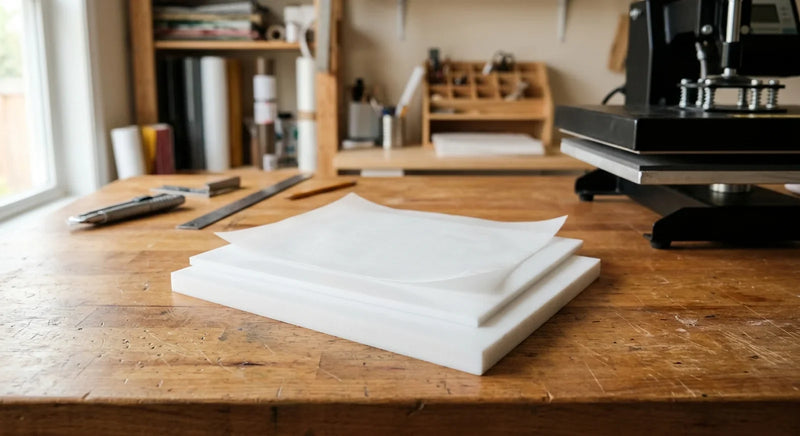
I've ruined more garments than I care to admit because I skipped the nonstick sheet. Adhesive residue caked on the platen, vinyl stuck to the press instead of the shirt, and one memorable sublimation disaster that left a permanent ghost image on everything I pressed for the next week. Don't be me. A good nonstick barrier is the cheapest insurance your heat press setup can have.
But here's the catch - there are four different types of nonstick paper for heat press work, and they're absolutely not interchangeable. The one you need depends on what you're pressing, how often, and whether you want something reusable or disposable.
Why Does Your Heat Press Need a Nonstick Barrier?
Heat press transfers involve adhesive-backed materials - HTV vinyl, sublimation ink, transfer paper - that activate under heat and pressure. Without a protective sheet between the press and your project, three things happen. Adhesive residue builds up on your platen over time. Transfer materials can bond to the press instead of your garment. And excess ink or adhesive bleeds onto your next project.
A nonstick sheet prevents all three problems. It sits between the upper platen and your transfer, catching anything that tries to escape. For sublimation, you'll also want one underneath the garment to catch ink bleed-through. This is non-negotiable if you're doing production work!
What Are the Four Types of Heat Press Nonstick Paper?
Silicone Release Paper is the most popular choice for daily heat press work. It starts with a dense glassine base coated with medical-grade silicone, which gives it significantly more strength and nonstick performance than grocery-store parchment. Our silicone release paper handles temperatures up to 450 degrees F and can be reused 5 to 15 times depending on the application. It's flexible, affordable, and works with HTV, sublimation, and screen print transfers.
PTFE Sheets (sometimes sold as "Teflon sheets") are woven or solid fluoropolymer fabric. They handle up to 500 degrees F and last for hundreds of presses. If you're running a small business and pressing 20 or more items a day, PTFE sheets pay for themselves within the first week. The per-press cost is essentially zero after the initial investment.
Teflon Pillow Pads are thicker PTFE-coated pads that add a slight cushion. They work well for uneven surfaces like seams, zippers, and raised logos. But they're not necessary for flat transfers - think of them as a specialty tool rather than an everyday essential.
Parchment Paper works in an emergency, but I wouldn't recommend it for regular use. It tears easily under pressure, tops out at about 420 degrees F, and is single-use. You'll spend more replacing parchment sheets than you would on a proper reusable option. It's the emergency spare tire of heat press supplies.
How Do Silicone Paper and PTFE Sheets Compare?
This is the question I hear most from people setting up their first press. Here's the breakdown:
| Feature | Silicone Release Paper | PTFE Sheet | Parchment Paper |
|---|---|---|---|
| Max Temperature | 450 degrees F | 500 degrees F | 420 degrees F |
| Reusability | 5-15 presses | Hundreds of presses | 1-2 presses |
| Nonstick Level | High | Very High | Moderate |
| Flexibility | Very flexible | Semi-rigid | Very flexible |
| Best For | Daily HTV and sublimation | High-volume production | Emergency backup |
| Cost Per Press | Low | Lowest | Highest |
And here's my honest take: if you're pressing fewer than 10 items a week, silicone release paper is your best value. It's cheaper upfront and plenty durable for hobby-level use. But once you cross into 10 or more presses daily, switch to PTFE sheets. The upfront cost is higher, but you'll save money within the first month.
What Temperature Should You Use with Each Material?
Your nonstick material needs to handle whatever temperature your transfer requires - plus a safety margin. Most HTV vinyl presses at 305 to 325 degrees F. Sublimation runs hotter, usually 380 to 400 degrees F. Specialty transfers like DTF can go up to 330 degrees F.
Silicone release paper handles all of these comfortably at 450 degrees F max. PTFE goes even higher at 500 degrees F. The only material that gets risky is parchment paper - at 420 degrees F max, it can scorch during high-temperature sublimation work. I've seen parchment turn brown and brittle after a single 400-degree press cycle. Not ideal when it's sitting directly on your customer's garment!
Pro Tip: If you're doing sublimation, always check that your nonstick paper doesn't have its own coating that could off-gas at high temperatures. Our silicone release paper is specifically rated for heat press use - not all "parchment paper" at the grocery store is. The OSHA heat safety guidelines are worth reviewing if you're running a production environment.
How Do You Actually Use Nonstick Paper in a Heat Press?
Place the nonstick sheet directly on top of your transfer material before closing the press. The sheet sits between the upper platen and your project surface. For sublimation, add a second sheet underneath the garment to catch any ink that bleeds through - this is called a "blow-out sheet" and it saves your bottom platen from becoming a modern art piece.
Make sure the nonstick sheet extends at least an inch beyond the edges of your transfer on all sides. If adhesive or ink migrates past the edge of your design (and it will, eventually), you want it hitting the nonstick paper, not your platen.
After each press, check the sheet for residue buildup. Silicone paper can handle a light wipe with a damp cloth between uses. PTFE sheets are even easier - most residue just peels right off. Replace any sheet that shows signs of tearing, discoloration, or reduced nonstick performance.
So which should you start with? For most people setting up a new heat press workspace, I'd recommend a pack of silicone release paper plus one PTFE sheet. Use the silicone paper for daily pressing and keep the PTFE sheet as your workhorse for longer production runs. Our step-by-step heat press release paper guide walks through the full setup process if you want more detail.
Can You Reuse Nonstick Heat Press Paper?
Yes - and reusability is one of the biggest reasons to invest in proper nonstick materials. A single PTFE sheet can last through hundreds of press cycles. Even silicone release paper, which is technically disposable, gives you 5 to 15 solid uses per sheet before the coating starts to degrade.
Quick math: a 50-sheet pack of our silicone release paper runs about $12. At 10 uses per sheet, that's 500 press cycles for twelve bucks. Compare that to single-use parchment at roughly $0.15 per sheet - you'd spend $75 to get the same 500 presses. The EPA's waste reduction guidelines make a solid case for reusable materials whenever possible, and this is one area where the math actually works in your favor.
But know when to retire a sheet. If it starts sticking, tears, or develops brown spots, it's done. Using a compromised nonstick sheet is worse than using none at all because it creates a false sense of security.
Shop Heat Press Supplies
Get the right nonstick protection for your press - from silicone release paper to PTFE sheets and silicone pressing pads.
Shop Heat Press Supplies | Nonstick Papers | Heat Press and Vinyl Craft Supplies
The bottom line? Don't cheap out on your nonstick barrier. It's the single most cost-effective accessory for any heat press, and the right one pays for itself faster than almost anything else in your setup. And if you want a deeper comparison of all three nonstick material types, our silicone vs PTFE vs FEP guide covers the full picture.