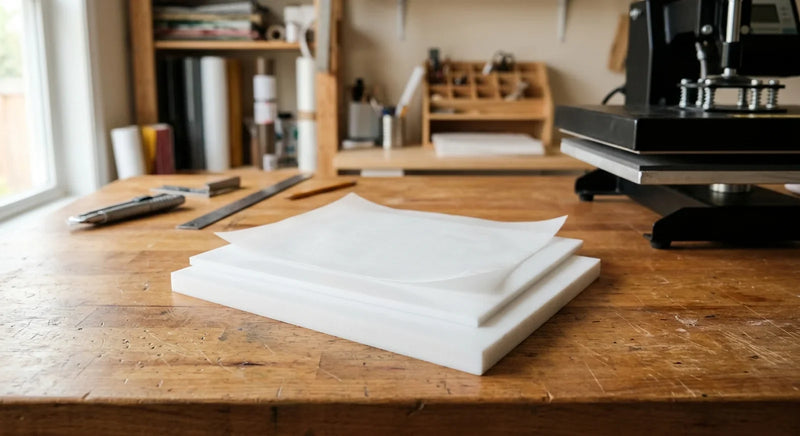
Release paper for heat press work is one of those supplies that seems optional until you ruin your first project without it. I pressed a beautiful multi-color HTV design onto a hoodie, flipped it to press the back, and watched the front design melt onto my lower platen. Twenty minutes of work, gone. A two-dollar sheet of release paper would’ve prevented the whole disaster.
If you’re doing any kind of heat transfer - HTV, sublimation, screen print transfers, or DTF - you need a barrier between your project and the press. Here’s exactly how to use one!
What Type of Release Paper Works Best for Heat Pressing?
Not all release papers handle heat press temperatures. Regular parchment paper from the grocery store tops out around 425°F and degrades quickly with repeated use. For heat pressing, you want one of two materials: silicone release paper or PTFE nonstick sheets.

Release paper is a coated sheet material designed to protect adhesive surfaces and provide a non-stick barrier, commonly used in diamond painting as a cover sheet to protect the sticky canvas while working section by section.
Silicone release paper has a true silicone coating (not the thin silicone-adjacent coating on baking parchment). It handles heat press temperatures and can be reused 2-3 times before the coating wears. It’s lighter, flexible, and cheap enough to use as a consumable.
professional PTFE sheets are the heavy-duty option. They handle temperatures well above any heat press setting, they’re reusable for hundreds of cycles, and they provide a smoother, more consistent barrier. The tradeoff is they cost more upfront, but per-use they’re significantly cheaper than any disposable option.
According to the Specialty Graphic Imaging Association (PRINTING United Alliance), using a protective barrier sheet on every press is industry standard practice for reducing defects and extending equipment life.
How Do You Position Release Paper for HTV Projects?
Placement is simple but matters! For standard HTV application, you need release paper in two places: on top of your design (between the HTV and the upper platen) and underneath your garment (between the fabric and the lower platen).
The top sheet prevents your upper platen from touching the vinyl directly, which can cause the carrier sheet to stick or the vinyl to melt onto the press. The bottom sheet prevents press-through, which is when heat and pressure push adhesive or dye through the fabric onto your lower platen.
For multi-layer HTV designs, use a release paper between each pressing step. When you press the second layer, the first layer is already bonded and vulnerable to re-melting. A release paper on top protects the previously pressed layers from direct heat contact.
What About Sublimation and DTF Transfers?
Sublimation and DTF (direct-to-film) transfers have different release paper needs than HTV.
For sublimation, the release paper goes underneath your substrate to catch any sublimation ink that bleeds through. Sublimation dye turns into gas at pressing temperature, and that gas will transfer onto anything it touches, including your lower platen. One contaminated platen can ghost images onto every project after that.
I also put a sheet on top of my sublimation transfers as a barrier against any ink that might transfer upward. Sublimation ink loves to migrate to unintended surfaces!
DTF transfers are generally more forgiving, but using a bottom barrier is still good practice. The powder adhesive on DTF films can leave residue on your platen over time.
How Do You Handle Double-Sided Pressing?
This is where most beginners get burned, literally. You press the front of a shirt, flip it over to press the back, and now the front design is face-down on your hot lower platen.

But the fix is always having a release paper on your lower platen. Before you flip the garment, make sure a heat-resistant PTFE or silicone paper is covering the bottom. The front design sits on the nonstick surface and won’t transfer, melt, or stick.
For projects that need pressing from both sides (like thick hoodies or items where you want extra adhesion), use the sandwich method: release paper on bottom, garment, release paper on top. Flip and repeat. The release paper barrier protects each side while you press the other.
What temperature and Time Settings Should You Adjust?
Here’s something important: adding a release paper between your project and the press doesn’t change your temperature or time settings. A thin PTFE sheet or silicone paper doesn’t block enough heat to affect the transfer.
What it does affect is heat-up time on your first press of the day. If your platen needs to heat through the release paper to reach the garment, give it an extra 2-3 seconds. But your actual pressing temperature and duration stay the same as whatever the vinyl manufacturer recommends.
The one exception is stacking multiple sheets. If you’re using a thick silicone pad plus a PTFE sheet on top, you might need to add a couple seconds to compensate for the combined insulation. But a single sheet of release paper? No adjustment needed.
Research from the Textile Research Journal confirms that thin polymer barrier films have negligible thermal resistance at heat press operating temperatures.
How Long Does Release Paper Last in a Heat Press?
Silicone release paper typically lasts 2-3 press cycles before the coating starts degrading. You’ll notice it losing its slick feel and starting to stick slightly. When that happens, replace it.
PTFE craft sheets last dramatically longer - hundreds of press cycles if you take basic care. Wipe them down between uses to remove adhesive residue, don’t cut on them, and store them flat. A single PTFE sheet can easily last a small business months of daily pressing.
Shop Related Products
Shop Release Paper and Nonstick Sheets
Protect every press with the right barrier. Our nonstick papers collection has silicone release paper in multiple sizes, and our PTFE sheets come in various thicknesses for light-duty to heavy production use. Starting a heat press setup? Grab both and see which fits your workflow better.
Related Reading
- What Is heat press Parchment Paper and How to Choose the Best One?
- Release Paper for Resin Projects: Stop Ruining Your Table
- Diamond Painting Release Paper: The Complete Guide for Beginners