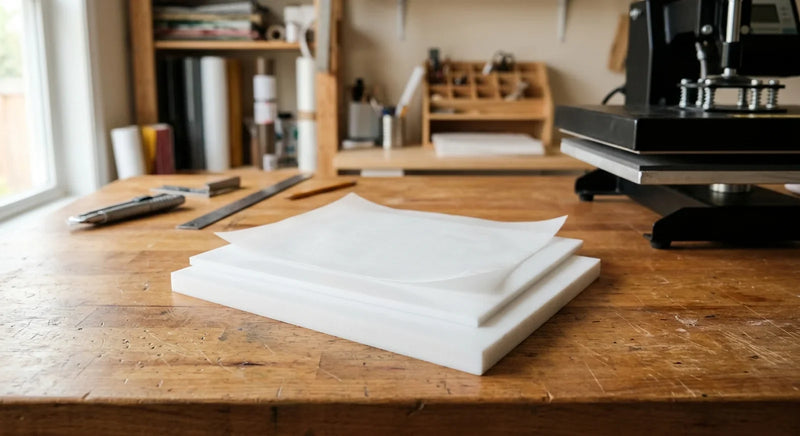
I ruined a perfectly good kitchen table with epoxy resin before I figured out that newspaper and plastic wrap aren’t real workspace protection! That mistake cost me a weekend of sanding and refinishing, plus the lingering resentment of my partner. A silicone crafting mat would’ve cost me about fifteen bucks.
If you work with heat, adhesives, resin, or anything that sticks, drips, or melts, a silicone mat is the single best investment you can make for your workspace. Here’s what you need to know before you buy one.
What Makes a Good Silicone Crafting Mat?
Not all silicone mats are created equal. The cheap ones from dollar stores are thin, floppy, and start curling up at the edges after a few uses. A good crafting mat needs three things: adequate thickness (at least 1.5mm for light crafts, 2mm+ for resin and heat press work), proper heat resistance (most quality silicone handles up to 480°F), and enough surface area for your projects.

A silicone mat is a flexible, heat-resistant non-stick pad used to protect work surfaces during crafting, baking, and resin projects, providing a reusable and easy-to-clean barrier against adhesives, heat, and chemical spills.
Thickness matters more than most people realize. A thin mat shifts around while you’re working, and it doesn’t provide enough insulation to protect the surface underneath from heat transfer. I’ve seen people burn countertops through cheap silicone mats during heat pressing.
The National Institute of Standards and Technology research on silicone polymers confirms that higher-density formulations maintain their non-stick properties significantly longer under repeated thermal cycling, which is exactly what happens when you use a mat for heat press work day after day.
How Do Silicone Mats Handle Heat Press Projects?
Heat pressing is probably where silicone mats prove their worth the fastest. Your press runs between 270-400°F depending on the material, and that heat has to go somewhere. Without a proper mat on your lower platen, you’re pressing that heat directly into whatever surface your press sits on.
A quality silicone pressing pad does three things during heat transfer: it provides even pressure distribution (no more hard spots causing uneven transfers), it insulates your work surface from heat damage, and it gives a slightly cushioned surface that helps the press conform to seams and raised areas on garments.
Why Are Silicone Mats Essential for Resin Work?
Resin and silicone don’t bond to each other. That’s the whole reason silicone molds work for resin casting. The same chemistry applies to silicone mats: pour resin on one, let it cure, and it peels right off. No solvents, no scraping, no damage.
I keep a dedicated silicone mat for my resin workspace. Drips, overflow, mixing spills - it all cures on the mat and peels away cleanly. Compare that to the alternatives: wax paper tears and absorbs resin, plastic wrap bunches up and sticks to everything, and aluminum foil leaves texture marks on any resin that touches it.
For larger resin projects like river tables or big trays, consider pairing a silicone mat with professional PTFE sheets for extended coverage. PTFE handles chemical exposure just as well and comes in larger sizes.
Picking the Right Size and Thickness?
Size depends on your primary craft. For heat press work, your mat should be at least as large as your press platen, ideally a couple inches bigger on each side to catch any overflow. For resin work, go bigger than you think you need. Resin has a talent for flowing exactly where you don’t want it.

Here’s a general guide based on what I’ve learned:
Standard sizes like 15x20 inches work for most tabletop crafts. If you’re doing garment pressing, match your platen size. The precut squares can work well for smaller projects or as portable options.
How Do Silicone Mats Compare to Other Workspace Protection?
The main alternatives are PTFE craft sheets, silicone release paper, and disposable options like parchment paper or plastic sheeting.
PTFE sheets are thinner and more heat-resistant than silicone mats. They’re ideal as a top layer during heat pressing but don’t provide the cushioning or insulation of a thick silicone pad. The smartest setup uses both: silicone mat as a base pad, PTFE sheet on top of your project.
Silicone release paper is a consumable, not a permanent surface protector. It’s great for diamond painting cover sheets, between-layer protection, and light-duty non-stick applications. But it isn’t thick enough to replace a proper mat.
Research from the American Chemical Society on fluoropolymer and silicone surface properties shows that silicone maintains its non-stick characteristics through more thermal cycles than paper-based alternatives, making it the better long-term investment.
How Do You Care for a Silicone Crafting Mat?
Silicone is tough but not indestructible. Avoid cutting directly on it with sharp blades, as deep cuts compromise the non-stick surface. Clean it with warm soapy water after use, and avoid abrasive scrubbers.
For resin residue that’s fully cured, flex the mat and the resin should pop right off. For stubborn spots, isopropyl alcohol softens the bond without damaging the silicone.
Store your mat flat or rolled (not folded). Folding creates creases that may not fully flatten out, leaving uneven spots in your workspace.
Shop Related Products
Shop Silicone Mats and Workspace Protection
Ready to protect your workspace the right way? Our silicone pads and trivets collection has options for every craft and budget, from compact pressing pads to full-size workspace mats. Pair one with a PTFE nonstick sheet for the ultimate heat press setup.
The bottom line is simple: a good silicone mat pays for itself the first time it saves your table from a resin spill or heat press burn. Get one before you need one.
Related Reading
- 7 Heat Press Mistakes That Keep Ruining Your Projects
- What Is heat press Parchment Paper and How to Choose the Best One? Period.
- Silicone vs PTFE vs FEP: Which Nonstick Material Do You Need?