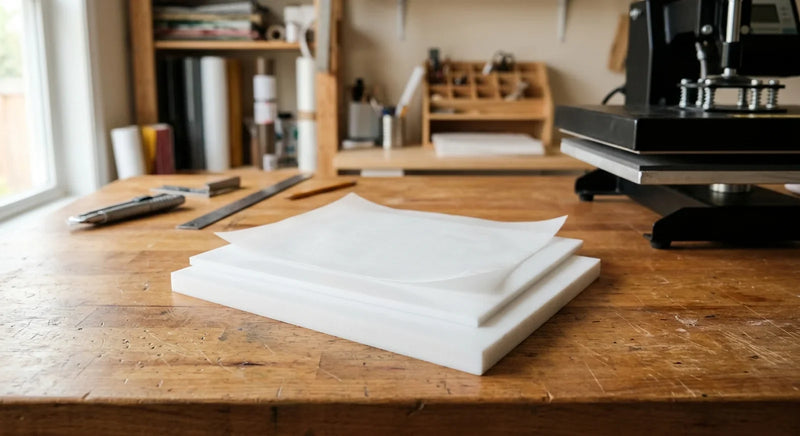
Here’s something most crafters don’t think about: the film covering your resin printer’s vat, the sheet protecting your heat press platen, and the non-stick liner in some high-end cookware all use the same material. It’s called FEP, short for fluorinated ethylene propylene, and once you understand what it does, you’ll start noticing it everywhere.
FEP belongs to the fluoropolymer family - the same chemical clan as PTFE (Teflon). Both materials share that trademark slippery, nothing-sticks-to-me quality. But FEP has properties that make it better suited for certain jobs, especially ones where you need to see through the material or work at lower temperatures.

What Is FEP Film and Where Does It Come From?
FEP stands for fluorinated ethylene propylene. It’s a synthetic fluoropolymer, which means it’s a plastic made from fluorine-containing monomers. The fluorine atoms create an extremely low-energy surface that resists bonding with almost everything: adhesives, resins, food, paint, you name it.
Think of it like the non-stick coating on your best frying pan, except FEP isn’t a coating. It’s the material itself, all the way through. So this means you can’t scratch through it to expose a sticky underlayer. The non-stick property is inherent to the entire thickness of the film.
FEP is typically manufactured as a thin, transparent film ranging from 0.025 mm to 0.25 mm thick. At the thinner end, it’s flexible enough to bend and conform to surfaces. At the thicker end, it holds its shape as a rigid sheet!
How Does FEP Compare to PTFE?
Since FEP and PTFE are both fluoropolymers, people often wonder why both exist. The key differences matter for choosing the right one.
PTFE handles higher temperatures. It stays stable up to about 260°C (500°F), while FEP tops out around 200°C (392°F). For heat press work at the higher end of the temperature range, PTFE is the safer choice.
FEP is transparent. PTFE is typically opaque white. If you need to see through the material - as in resin printing, where UV light must pass through the vat film - FEP is the only option.
FEP can be heat-welded and melt-processed, which makes it easier to manufacture into complex shapes. PTFE requires sintering (a pressure-and-heat process similar to ceramics), which limits its forms.
FEP has lower friction than PTFE at room temperature. This sounds counterintuitive since PTFE is literally Teflon, but FEP’s molecular structure gives it a slight edge in slipperiness at normal craft-room temperatures.
For most crafting applications, either material works. But where transparency, lower processing temperatures, or maximum slipperiness matters, FEP pulls ahead.

How Do Crafters Use FEP Film?
FEP film shows up in more craft applications than you’d expect. Here are the ones where it actually makes a practical difference.
Resin 3D Printing
This is FEP’s most well-known craft application. In resin printers (SLA and DLP types), the bottom of the resin vat is a sheet of FEP film. UV light shines through the transparent FEP to cure liquid resin one layer at a time. After each layer cures, the build plate lifts, and the cured layer peels away from the FEP surface.
The FEP needs to be transparent (so light passes through), non-stick (so cured resin releases cleanly), and chemically resistant (since it’s submerged in liquid resin for hours). FEP checks all three boxes.
Most resin printers ship with FEP film installed, but it wears out after roughly 10-20 liters of resin processed. Replacement sheets run about $5-15 depending on the printer size. When the film gets cloudy, scratched, or starts causing print failures, it’s time to swap.
Resin Crafting (Non-3D Printing)
FEP sheets work as release surfaces for hand-poured resin projects too. If you’re making resin jewelry, coasters, or art pieces, placing them on FEP film during curing means the bottom surface comes out perfectly smooth and glossy!
The advantage over silicone release paper for resin work is durability. A single FEP sheet can handle hundreds of resin pours before showing wear. Silicone paper lasts for dozens. The tradeoff is cost - FEP sheets cost more upfront.
FEP is also completely transparent, which means you can cure UV resin by shining light through the film from below. This is useful for making thin resin pieces like jewelry bezels where you want the bottom surface to cure completely.
Heat Press and Transfer Work
FEP film works as a press-through protector for heat transfer projects, similar to PTFE craft sheets. It sits between your heat press platen and the garment, preventing adhesive and ink from reaching the press surface.
At temperatures below 200°C, FEP performs well. Most HTV (heat transfer vinyl) applications run between 150-180°C, which is within FEP’s comfortable range. For sublimation work that hits 200°C or higher, stick with nonstick PTFE material instead.
The transparency of FEP is an advantage here - you can see your design through the film while positioning it, which helps with alignment. With opaque PTFE, you’re working blind once the sheet goes down.
Painting and Art Projects
Some artists use FEP film as a palette surface or a non-stick work surface for mixed media projects. Acrylic paint, oil paint, and most art media peel cleanly off FEP once dry.
FEP’s transparency also makes it useful as a tracing or transfer medium. You can lay it over a reference image, trace with certain markers, then transfer the traced image to your working surface.

Picking the Right FEP Film Thickness?
FEP film comes in several thicknesses, and choosing the right one depends on your application.
0.05 mm (50 microns) is the standard thickness for resin printer vats. It’s thin enough to flex during the peel process but tough enough to resist punctures from the build plate.
0.1 mm (100 microns) offers more durability for general craft use. It’s thick enough to handle as a standalone sheet without tearing, and it resists punctures better than the thinner option.
0.15-0.25 mm is semi-rigid and works well as a reusable work surface or heat press protector. It lies flat without curling and can be cleaned and reused many times.
My advice: for most craft purposes, the 0.1 mm thickness hits the sweet spot between flexibility, durability, and cost.
How Do You Care for FEP Film?
FEP film lasts a long time if you treat it right. Here’s what actually helps:
Clean with isopropyl alcohol (IPA) after resin work. Uncured resin washes off FEP easily with IPA. Let the sheet dry completely before the next use.
Avoid abrasive cleaning. FEP is scratch-resistant but not scratch-proof. Paper towels are fine, but steel wool or rough scrub pads will haze the surface. Once hazed, the optical clarity drops, which matters for resin printing.
Store flat. Like silicone heat-safe release paper, FEP film develops memory creases if stored rolled or folded. These creases create uneven surfaces that affect print quality and resin curing.
Keep away from sharp edges. FEP is tough but it’s still a thin film. A craft knife or the edge of a build plate can puncture it. Handle with care during installation and removal.
When to Choose FEP Over Other Non-Stick Materials?
FEP makes the most sense when you need transparency, chemical resistance, or maximum non-stick performance at moderate temperatures.
Choose FEP over PTFE when you need to see through the material, work below 200°C, or need the absolute lowest-friction surface.
Choose FEP over silicone release paper when you need hundreds of uses from a single sheet, chemical resistance against resins and solvents, or optical clarity.
Choose PTFE over FEP when working above 200°C, when you need a thicker protective sheet, or for heat press work at maximum temperatures.
Choose silicone release paper over FEP when cost per sheet matters most, when you need disposable protection, or for diamond painting cover sheets where transparency isn’t needed.
Shop Related Products
What Is the Practical Takeaway?
FEP film is one of those materials that most people don’t know about until they need it. And once they use it, they wonder how they managed without it. It’s not the right choice for every non-stick application - PTFE handles higher heat, and silicone paper costs less - but for the jobs where FEP excels, nothing else comes close.
If you’re working with resin in any form, FEP should be on your supply list. If you’re doing heat press work below 200°C and want to see your design during placement, FEP is worth trying. And if you just need a surface that nothing sticks to, period, FEP is about as close to frictionless as a solid material gets.