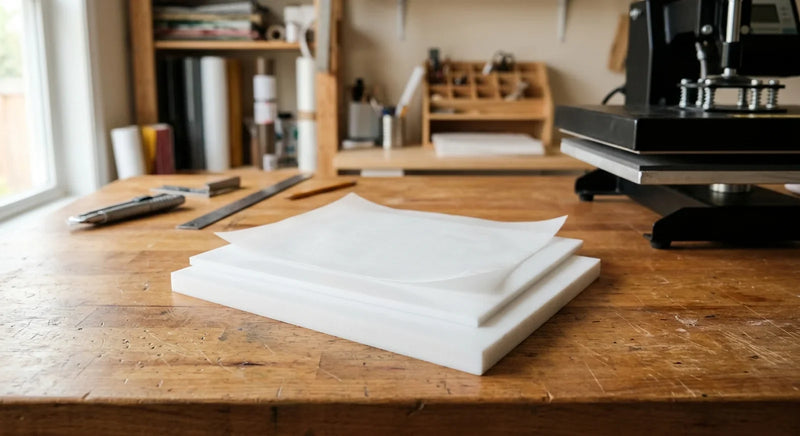
Quick math: a good silicone mat costs about $10-15. It handles resin pours, heat press jobs, baking sessions, and general craft workspace protection. It lasts years. The disposable alternatives you’d use instead - parchment paper, aluminum foil, plastic sheeting - cost more over six months of regular use than the mat costs once.
That’s the practical case for silicone mats. But there’s a more interesting reason crafters love them: a single mat replaces four or five single-purpose supplies. Less stuff to buy, less stuff to store, and your workspace stays cleaner.

What Makes Silicone Mats Different from Other Work Surfaces?
Silicone crafting mats are made from food-grade silicone rubber, the same material used in baking molds and kitchen spatulas. The silicone is typically reinforced with a fiberglass mesh core that prevents tearing and keeps the mat lying flat.
A silicone mat is a flexible, heat-resistant non-stick pad used to protect work surfaces during crafting, baking, and resin projects, providing a reusable and easy-to-clean barrier against adhesives, heat, and chemical spills.
And the key property is heat resistance. Most silicone mats handle temperatures from -40°C to 230°C (-40°F to 446°F) without degrading. So this means you can use the same mat under a heat press at 180°C and then throw it in the freezer to help demold a resin project. Try that with a plastic mat.
The non-stick surface is the other big advantage. Cured resin peels off. Dried paint peels off. Hot glue peels off. Melted HTV adhesive peels off. Almost everything crafters work with releases from silicone without scraping or solvents.
The mat itself is about 2-3 mm thick, which provides enough cushion to protect your table from heat, scratches, and spills, but thin enough that it doesn’t create an unstable work surface for detailed projects.
How Do Silicone Mats Protect During Heat Pressing?
If you do any heat transfer work, a silicone mat belongs under your press or between your press and the garment.
The mat serves two purposes during heat pressing. First, it protects your lower platen from adhesive bleed-through. HTV adhesive that seeps through fabric will bond permanently to an unprotected platen. A silicone mat catches that adhesive and releases it after the press cools.
Second, it provides a cushioned surface that helps distribute pressure evenly across the design. On a bare metal platen, raised areas like seams and zippers can cause uneven pressure. The slight give in a silicone mat compensates for these variations.
For sublimation work, silicone mats prevent ghost images. Sublimation ink that passes through the substrate can stain unprotected surfaces and then transfer onto the next project. The silicone surface won’t absorb the ink, so there’s nothing to transfer.
How Do Silicone Mats Help with Resin Crafting?
Silicone mats are popular with resin crafters for a simple reason: cured epoxy resin doesn't bond to silicone. You can pour, drip, splash, and overflow all over a silicone mat, let it cure completely, and then flex the mat to pop off the cured resin like ice from a tray.
This makes cleanup between projects trivial. Instead of scraping resin off your table or peeling it off disposable coverings, you just flex and peel. The mat goes right back down for the next pour.
For resin work specifically, look for a mat that lies completely flat. Any curl or buckle creates an uneven surface, and resin is self-leveling - it'll flow toward the lowest point. A mat that curls at the edges means resin pooling against the curl.
One limitation worth noting: silicone mats are not transparent, so you can’t UV-cure resin through them from below the way you can with FEP film. For projects that need bottom curing, use FEP film on top of the silicone mat - the mat protects your table while the FEP provides the transparent curing surface.

Can You Use Silicone Mats for Baking and Kitchen Work?
The same properties that make silicone mats good for crafting make them good for baking. Non-stick surface, heat resistance up to 230°C, easy cleanup. A silicone baking mat replaces parchment paper for most applications.
Cookies slide off without greasing. Roasted vegetables don’t stick. Bread dough doesn’t adhere during kneading. And unlike parchment paper, the mat goes back in the drawer after washing instead of into the trash.
From what I've seen, the economics are simple. A roll of parchment paper costs $4-6 and lasts maybe 20 baking sessions. A silicone mat costs $10-15 and lasts 2,000+ sessions if you take basic care of it. Over two years of weekly baking, parchment costs roughly $20-30. The mat paid for itself after the third month.
There are a few things silicone mats don’t do well in the kitchen. They can’t go under a broiler (too close to the heating element). They don’t give you the same crispness on the bottom of baked goods that a bare sheet pan does - the insulating property that protects your table also slows bottom browning slightly! And they’re not great for candy making at temperatures above 230°C!
Picking the Right Size and Thickness?
Silicone mats come in sizes from small (20 x 30 cm, about a sheet of paper) to extra large (60 x 40 cm, a full countertop section). Picking the right size depends on how you’ll use it.
For heat press work, match the mat to your press platen size. A 38 x 38 cm mat works with most 15-inch presses. Going larger than your platen wastes counter space. Going smaller leaves your table exposed.
For resin crafting, go bigger than you think you need. Resin drips travel further than expected, and a mat that’s too small just moves the cleanup problem from the table to the table edge. A 60 x 40 cm mat gives most crafters enough coverage.
For baking, standard half-sheet pan size (42 x 29 cm) covers the most common baking sheet. Full-sheet size (60 x 40 cm) works for commercial or oversized pans.
Thickness matters too. Thin mats (1 mm) roll easily for storage but don’t provide much table protection or cushion. Medium mats (2-3 mm) balance flexibility with protection. Thick mats (4-5 mm) offer maximum table protection but they’re harder to store and can feel spongy for detailed work.

How Do You Care for Your Silicone Mat?
Silicone mats require minimal maintenance, but a few habits extend their life significantly.
Wash with warm soapy water after each use. Dish soap works fine. Avoid abrasive scrubbers - they can roughen the surface over time, which reduces the non-stick properties.
Don’t cut on the mat. Craft knives and rotary cutters will score the surface. Those scores become channels where resin, paint, and other materials can settle permanently. Use a separate cutting mat for any cutting work.
Store flat or loosely rolled. Folding creates permanent creases. If you must roll it, roll it loosely around a cardboard tube rather than folding it tight.
I've seen this mistake plenty of times - avoid direct flame. Silicone is heat-resistant, not fireproof. A heat gun for resin bubble removal is fine at a safe distance. A propane torch is not.
Replace when the non-stick surface degrades. Over years of heavy use, the silicone surface can become slightly tacky or develop permanent discoloration. A mat that’s starting to grip materials instead of releasing them has reached the end of its useful life.
How Does a Silicone Mat Compare to Other Workspace Protection?
Silicone mats aren’t the only option for workspace protection. Here’s how they compare to the alternatives in real-world use.
Silicone release paper is thinner, cheaper per sheet, and disposable. It’s better for diamond painting cover sheets and situations where you want a fresh surface every session. But it’s single-use or limited-use, and it doesn’t provide heat protection or cushioning.
PTFE sheets handle higher temperatures (up to 260°C vs 230°C for silicone) and are thinner. They’re better for high-temperature heat press work. But they don’t provide table protection from spills, and they’re smaller.
Plastic sheeting is cheap but sticks to resin, melts under heat, and wrinkles constantly. It’s barely better than nothing for craft protection.
Newspaper works in a pinch but absorbs liquids, tears easily, and bonds permanently to cured resin. Not recommended.
For most crafters who work across multiple disciplines, a silicone mat is the best single investment in workspace protection. It handles 80% of situations well, and you can add specialized materials (PTFE for extreme heat, craft release paper for diamond painting) for the other 20%.
Shop Related Products
Is a Silicone Mat Worth the Investment?
Most craft supply purchases solve one problem. A silicone mat solves about five. It protects your table from heat, resin, paint, adhesive, and scratches. It cleans up in 30 seconds with soap and water. It lasts for years. And it costs less than two months of disposable alternatives.
If you’re working with any combination of heat, adhesive, or resin, a silicone mat should be the first thing on your workspace. Not because it’s exciting - nobody gets excited about a mat - but because every project goes smoother when your work surface handles whatever you throw at it.