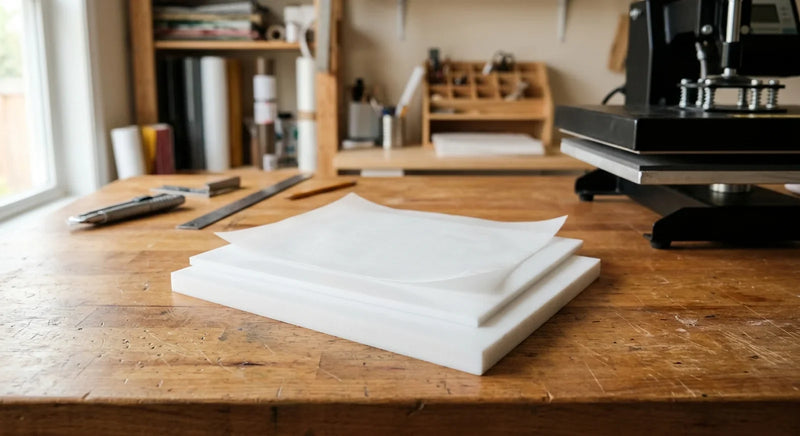
A replacement heat press platen costs $40-80. A nonstick PTFE material costs $8-12. One sits between your press and your project, catching every drop of adhesive that bleeds through, every bit of sublimation ink that overshoots, every scorch mark that would otherwise become permanent. The math on this one isn’t complicated.
But cost protection is only half the story. A PTFE sheet actually improves your press results - more even heat distribution, cleaner transfers, and fewer ruined garments. We’ve watched customers go from fighting inconsistent presses to getting clean results every single time, just by adding this one layer.

What Is PTFE and How Does It Work?
PTFE stands for polytetrafluoroethylene. You probably know it as Teflon - same material that coats non-stick pans. In sheet form, it’s a thin, flexible, heat-resistant film that nothing sticks to.
Your heat press generates controlled temperature and pressure across a flat surface, and the PTFE sheet you place inside protects both the substrate and the machine.
The numbers matter here. PTFE handles continuous temperatures up to 260 degrees Celsius (500 degrees Fahrenheit) without degrading. Standard heat press work runs between 150-200 degrees Celsius. So you’ve got a comfortable 60-100 degree margin before the sheet even starts to stress! That margin means your PTFE sheet won’t warp, melt, or break down during normal pressing.
The non-stick property comes from PTFE’s molecular structure - it has one of the lowest coefficients of friction of any solid material. HTV adhesive, sublimation ink, and melted vinyl all release cleanly from the surface. No scraping, no residue, no transfer to the next project.
heat-resistant PTFE are typically 0.13-0.25 mm thick. Thin enough that heat passes through efficiently to your transfer, thick enough to provide a reliable barrier between the press and your work.
What Three Problems Does a PTFE Sheet Solve?
Every heat press operator eventually runs into the same three issues. A professional PTFE sheet prevents all of them.
Adhesive Bleed-Through
When you press HTV onto fabric, the adhesive on the back of the vinyl melts and bonds to the fabric fibers. That’s how it works. But some of that melted adhesive seeps through the fabric weave and reaches whatever surface is underneath.
On a bare platen, that adhesive bonds permanently. After a few dozen presses, your platen has a sticky, uneven coating that transfers residue to every garment you press. Cleaning a contaminated platen is tedious and sometimes impossible without damaging the surface.
A PTFE sheet catches that adhesive. After the press cools, the adhesive peels right off the PTFE surface. Wipe it down, and it’s ready for the next press. Five seconds of cleanup versus an hour of platen scrubbing.
Scorch Marks and Shine
Direct contact between a hot press plate and fabric causes scorching on sensitive materials. Dark polyester gets shiny. Delicate cotton yellows. Even a few degrees too hot or a few seconds too long can leave visible marks.
A PTFE sheet creates a buffer layer. It distributes heat slightly more evenly across the surface and prevents the metal plate from making direct contact with your fabric. The result: fewer hot spots, less scorching, and no unwanted shine on dark materials.
This matters especially for polyester and poly-blend fabrics. Direct metal-to-polyester contact above 175 degrees Celsius almost always produces a visible sheen. The PTFE barrier eliminates that problem.
Sublimation Ghost Images
Sublimation ink turns into gas under heat and bonds with polyester fibers. Any ink that doesn’t bond with your substrate keeps traveling - into the platen, into the pad below, into whatever surface is nearby.
That stray ink then releases during your next press, creating faint ghost images on the next garment. We’ve heard from customers who pressed a bright red design, then found pink shadows on the next three white shirts they ran through the machine.
PTFE won’t absorb sublimation ink. The gas hits the sheet, cools, and sits on the surface as a faint residue that wipes off. No absorption means no ghost transfer.

How Should You Position Your PTFE Sheet?
Placement depends on what you’re pressing, but the general setup is simple.
In my experience, for HTV on garments, place the PTFE sheet on top of the vinyl, between the vinyl and the upper press plate. This protects both the vinyl from direct heat contact and the upper plate from adhesive. If you’re worried about bleed-through onto the lower platen too, use a second sheet underneath the garment.
For sublimation transfers, you want PTFE both above and below. Sheet on top prevents the upper plate from absorbing stray ink. Sheet underneath catches ink that passes through the substrate. Some people use butcher paper on top instead - it works but it’s single-use. PTFE gives you the same protection for hundreds of presses.
For layered HTV projects (multiple vinyl colors stacked), place a PTFE sheet between each press layer. When you’re pressing the second color, the sheet protects the already-pressed first layer from re-melting or shifting under direct heat.
What About Temperature and Time: PTFE Doesn’t Change Your Settings?
One concern we hear: does a PTFE sheet affect press temperature or time? The short answer is no, not in any meaningful way.
PTFE is thermally transparent at the thicknesses used for heat press sheets. A 0.15 mm sheet adds roughly 1-2 seconds to heat-through time. For a standard 15-second press, that’s negligible. You don’t need to increase temperature or extend time to compensate for the sheet.
If you’re following manufacturer-recommended settings for your HTV or sublimation paper, keep those exact settings when pressing through PTFE. The results will be identical, with the added benefit of protection.
The exception: if you’re stacking multiple sheets (PTFE above and below, plus a Teflon pillow inside the garment), the combined insulation can add 3-5 seconds of heat-through time. In that scenario, add 2-3 seconds to your press time. But a single sheet on top? No adjustment needed.
How Do PTFE Sheet vs Parchment Paper vs Silicone Mat Compare?
Three common materials get used as heat press barriers. They’re not interchangeable.
Parchment paper is cheap and disposable. It handles temperatures up to about 220 degrees Celsius before it browns and becomes brittle. For quick HTV jobs under 200 degrees, it works fine as a one-time barrier. But it doesn’t last - one press and it’s done. Over a month of regular pressing, parchment costs more than a PTFE sheet that would've covered every one of those presses.
Silicone mats provide cushioning and heat protection up to 230 degrees Celsius. They’re great as a lower platen cover for table protection and even pressure distribution. But they’re 2-3 mm thick, which means they insulate more than PTFE and can affect press-through times. They also don’t work well as a top cover because the thickness prevents close contact between the heat plate and the transfer.
PTFE craft sheets are the purpose-built solution for heat press work. Thinnest profile (doesn’t affect heat transfer), highest temperature tolerance (260 degrees Celsius), best non-stick performance, and reusable for hundreds of presses. For the upper barrier between your press and your work, PTFE is the right material.
The ideal setup for most heat press users: PTFE sheet on top, silicone mat on the bottom. Top layer handles precision heat transfer and adhesive protection. Bottom layer handles table protection and pressure cushioning.

How Do You Get the Most Life from Your PTFE Sheet?
A well-maintained PTFE sheet lasts 200-500 presses, depending on what you’re pressing and how you care for it.
Wipe it down after every pressing session. Warm, damp cloth removes adhesive residue and sublimation ink before they build up. Letting residue accumulate eventually creates a film that reduces the non-stick performance.
What I always tell people is that don’t fold the sheet for storage. Creases become permanent weak points that eventually crack. Roll it loosely or lay it flat. If you’re short on space, roll it around a cardboard tube.
Replace when you see signs of degradation. The surface should feel smooth and slick. If it starts feeling rough, tacky, or develops visible cracks, the PTFE coating is breaking down. Pressing with a degraded sheet can actually transfer residue onto your garments - the opposite of what you want.
Keep a spare. When your current sheet starts showing wear, you don’t want to pause production while you wait for a replacement to arrive. PTFE sheets are cheap enough that keeping one backup makes sense.
Shop Related Products
What Should You Remember?
A PTFE sheet is one of those supplies that doesn’t seem important until you’ve ruined a platen or ghosted a customer’s shirt. Then it seems really important.
For under $12, you get a reusable barrier that prevents adhesive damage, eliminates scorch marks, stops ghost images, and lasts through hundreds of presses. It doesn’t change your press settings. It doesn’t complicate your workflow. It adds maybe two seconds to your setup time.
If you own a heat press, you need a PTFE sheet between it and your work. Not eventually. Now. The cost of not having one is always higher than the cost of the sheet itself.