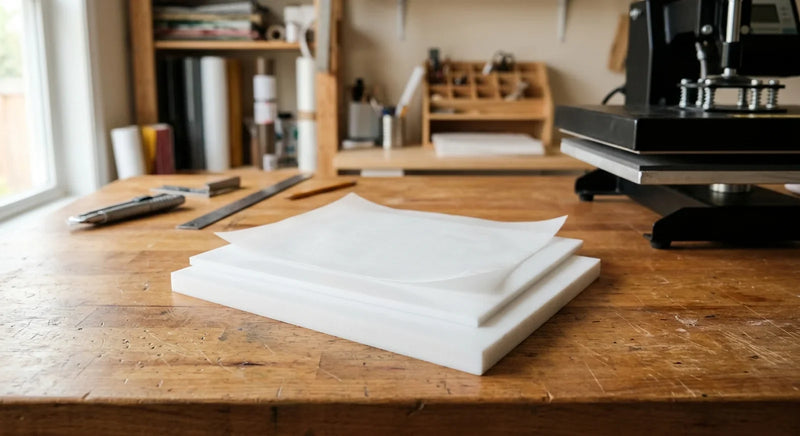
Here's something most crafters don't think about: the coating on your nonstick paper matters more than the paper itself. Think of it like cookware. A cheap nonstick pan works fine for a week, then everything starts sticking. The same principle applies to release papers and nonstick films - the material science behind the coating determines everything from durability to heat resistance to what you can actually use it for.
I've tested all three of these materials extensively, and each one has a clear sweet spot. FEP film is the most nonstick and transparent option. Silicone release paper offers the best balance of performance and value for most craft uses. And standard parchment paper works for basic baking but falls short for anything more demanding. Let me break down exactly why.
What Is FEP Film and Why Do Crafters Love It?
FEP stands for fluorinated ethylene propylene. It's a transparent fluoropolymer from the same chemical family as Teflon, but in a clear, flexible sheet form. The key property? Nothing sticks to it. Period. FEP is completely nonstick, chemically inert, and heat-resistant up to 400 degrees F.
I first encountered FEP film when it gained popularity as the vat liner in resin 3D printers, where it needs to release cured resin layers cleanly thousands of times without degrading. But crafters quickly figured out it's useful for a lot more than that. Resin artists use it as a work surface because cured epoxy peels right off. Diamond painters use it as a transparent cover sheet. And industrial users rely on it for any application where you need to see through the material while keeping things from sticking.
Our FEP sheets come in multiple thicknesses for different applications. Thinner FEP (0.5mil) works great for 3D printer vats. Thicker FEP (2-5mil) is better for craft work where you need more durability.
What Makes Silicone Release Paper Different from Parchment?
This is where things get confusing, because both products technically have a silicone coating. But the similarity ends there.
Silicone release paper starts with a glassine base - a naturally smooth, dense paper that's already stronger than standard cellulose. On top of that goes a medical-grade silicone coating that's significantly thicker and more durable than what you'll find on grocery-store parchment. The result is a paper that can handle up to 450 degrees F, resists tearing under pressure, and maintains its nonstick properties through 5 to 15 uses.
Standard parchment paper uses a much thinner silicone treatment on regular cellulose paper. It maxes out around 420 degrees F, tears easily if you apply any real pressure, and is essentially single-use. It's designed to keep cookies from sticking to a baking sheet - not to survive repeated heat press cycles or protect a diamond painting canvas.
The practical difference? I've watched parchment paper disintegrate mid-press while silicone release paper came out looking barely used. It's not even close!
How Do All Three Materials Compare Side by Side?
| Feature | FEP Film | Silicone Release Paper | Parchment Paper |
|---|---|---|---|
| Material | Fluoropolymer (Teflon family) | Silicone-coated glassine | Silicone-coated cellulose |
| Heat Resistance | Up to 400 degrees F | Up to 450 degrees F | Up to 420 degrees F |
| Transparency | Crystal clear | Opaque (white/tan) | Semi-translucent |
| Reusability | Hundreds of uses | 5-15 uses | 1-2 uses |
| Nonstick Level | Highest | High | Moderate |
| Food Safe | Yes (FDA approved) | Yes (FDA compliant) | Yes |
| Best Uses | 3D printing, resin, lab work | Heat press, crafts, diamond painting | Baking, basic food prep |
| Cost Per Use | Lowest (long lifespan) | Low (multiple reuses) | Highest (single use) |
Which Material Works Best for Each Craft?
For heat press work: silicone release paper wins for most users. It handles the temperatures you need (HTV presses at 305-325 degrees F, sublimation at 380-400 degrees F), it's flexible enough to conform to garment surfaces, and the cost per press is minimal. PTFE sheets are even better for high-volume production, but silicone paper is the most practical starting point.
For diamond painting: both FEP and silicone release paper work, but they serve different purposes. FEP's transparency lets you see your canvas through the cover sheet, which is great for checking drill placement. Silicone paper is opaque but provides better adhesive protection when you're working section by section. Our diamond painting release paper guide covers the specific techniques for each.
For resin and epoxy work: FEP film is the clear winner. Cured resin peels off FEP like it was never there. Silicone paper works in a pinch for resin, but it can absorb small amounts of uncured resin over time. And parchment? It'll bond permanently to cured epoxy. Don't even try it.
For baking: parchment paper is actually fine here. Baking doesn't involve the pressure, repeated use, or chemical exposure that degrades parchment in craft applications. But if you want a reusable alternative, a silicone baking mat or silicone release paper both work and save money over time. Our baking mat vs parchment comparison covers the details.
Can You Reuse These Materials?
FEP film is by far the most reusable. A single sheet can last hundreds of uses in a 3D printer vat and even longer as a craft work surface. It doesn't absorb anything, doesn't degrade under UV light, and cleans up with just a wipe. The Chemours fluoropolymer resource center has detailed specs on FEP's chemical resistance if you want the technical details.
Silicone release paper gives you 5 to 15 uses depending on the application. Heat press work at high temperatures shortens the lifespan. Diamond painting cover sheet use, where there's minimal heat involved, gets you closer to the 15-use end. You'll know it's time to replace when the paper starts sticking or shows visible wear.
Parchment paper is one-and-done for anything beyond basic baking. And even for baking, it's typically single-use unless you're doing something very low-temperature.
What About Cost Per Use?
This is where the math gets interesting. FEP film has the highest upfront cost but the lowest per-use cost because it lasts so long. Silicone release paper sits in the middle - affordable upfront and reasonable per-use cost. Parchment paper is cheapest per sheet but most expensive per use because you're replacing it every single time.
In my experience, for a crafter doing 5 projects a week, silicone release paper at roughly $0.02 per use is hard to beat. For production environments doing 50 or more projects daily, FEP or PTFE sheets make more financial sense. The EPA's sustainable materials management guide reinforces that reusable materials almost always win on both cost and environmental impact over their single-use counterparts.
Shop Nonstick Materials
Find the right nonstick material for your project - from FEP film for resin work to silicone release paper for heat press and crafts.
Shop Nonstick Papers | PTFE and FEP Materials | All Craft Supplies
So which one should you grab? If you do one type of craft, match the material to the application using the table above. If you do a bit of everything (and most of us do), start with silicone release paper for everyday use and add FEP when you need transparency or maximum nonstick performance. Skip parchment unless you're only baking.