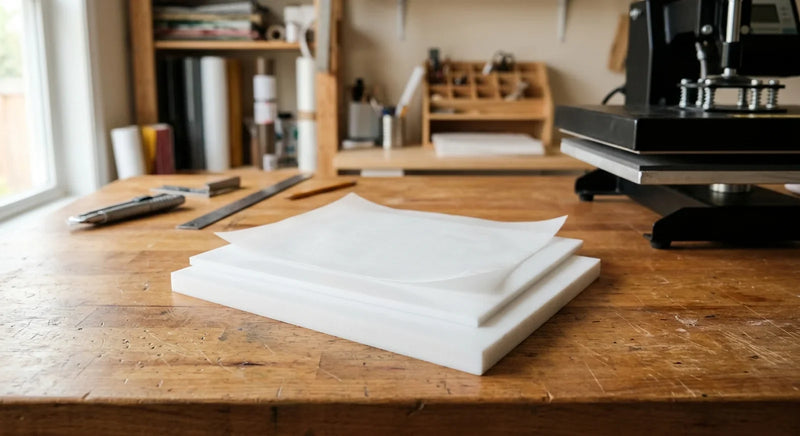
A friend of mine swapped to reusable baking mats about a year ago and hasn't looked back. Meanwhile, I still grab a sheet of parchment paper almost every time I bake. We've had this debate more than once over coffee, and the truth is - we're both right. It just depends on what you're making.
If you've ever stood in a kitchen supply aisle wondering which nonstick option actually belongs in your kitchen, you're not alone. We hear this question all the time from home bakers. So let's break it down.

What's the Real Difference Between Baking Mats and Parchment Paper?
A baking mat is a flexible, reusable sheet made from food-grade silicone (sometimes reinforced with fiberglass mesh). You lay it on your baking sheet, and it provides a nonstick surface that lasts for hundreds of uses. Most mats handle temperatures up to about 480°F.
Parchment paper is a cellulose-based paper coated with silicone on one or both sides. It's lightweight, disposable (or reusable a few times if you're careful), and can typically handle oven temps up to 425°F before it starts browning at the edges.
Both prevent food from sticking. But they behave differently during baking, and that's where the choice actually matters.
Silicone mats insulate the bottom of your pan slightly, which means cookies spread a bit more and bottoms brown more slowly. Parchment paper lets heat through more directly, giving you crispier edges. And if you're doing anything with sticky batters or caramel, parchment makes cleanup a breeze because you can just toss the sheet.
When Does Parchment Paper Work Better?
Parchment wins in a few specific situations that come up more often than you'd think.
For roasting vegetables, parchment is the better call. You want high heat and direct contact to get those caramelized edges, and a silicone mat can actually slow that process down. I roast broccoli at 425°F on parchment every week, and the difference in crispiness compared to using a mat is noticeable.
Parchment is also the better pick for anything involving sugar work or sticky glazes. Candied nuts, toffee, meringues - they all release cleanly from quality silicone-coated parchment paper without leaving residue. Try peeling caramel off a baking mat sometime. You'll understand.
For lining cake pans and loaf pans, parchment is really your only option. You can cut it to fit odd shapes, fold it into corners, and create a sling for easy removal. Mats are rigid and won't conform to anything that isn't flat.
And here's a practical one: if you're baking in batches (holiday cookies, anyone?), having multiple sheets of parchment ready to go lets you prep the next batch while the current one bakes. That kind of workflow is harder with mats since most people only own one or two.

When Should You Reach for a Baking Mat Instead?
Mats earn their spot for everyday baking tasks where you're using moderate temperatures and want zero waste.
Cookies are the classic mat territory. The slight insulation from a silicone mat actually helps here - it prevents the bottoms from browning too fast while the centers finish cooking. If you've ever had cookies that are crispy on the bottom but doughy in the middle, a mat might fix that for you.
Mats are also great for reusable nonstick baking in general. Sheet pan dinners, frozen foods, pizza rolls - anything where you'd burn through parchment paper regularly. One mat replaces hundreds of single-use sheets over its lifetime.
But the biggest advantage of mats is consistency. The surface is perfectly flat and uniform every time. No wrinkles, no bunching, no sliding around on the pan. For macarons and other precision baking, that consistency matters a lot!
Can You Use Silicone Release Paper for Baking?
This is a question we get surprisingly often, and it's a good one. Silicone release paper is different from standard parchment paper. It has a true silicone coating (not just a light treatment) that makes it more durable and provides a cleaner release.
The short answer? Yes, as long as it's food-safe rated. True silicone-coated paper can handle higher temperatures than regular parchment without degrading, and it's reusable for two to three sessions per sheet. That makes it a nice middle ground between disposable parchment and a full silicone mat.
So if you want the flexibility of paper (cutting to size, lining odd pans) with some of the durability of a mat, silicone release paper is worth trying. The FDA maintains guidelines on food contact materials that confirm silicone is safe for food use at standard baking temperatures.
I've been using silicone-coated paper for sheet pan dinners lately, and I get about three uses per sheet before it starts looking worn. For the cost difference, that's a solid deal!

Which Option Saves You More Money Over Time?
Let's do some quick math, because this is where the conversation gets interesting.
A roll of standard parchment paper runs about $4-6 and gives you roughly 20-25 sheets. If you bake twice a week, that's a new roll every two to three months - call it $20-30 per year.
A quality silicone baking mat costs $10-20 and lasts 1-3 years with regular use. So over three years, you're spending $10-20 total vs roughly $60-90 on parchment. The mat wins on pure cost.
But here's the catch. Most home bakers need both. You can't line a bundt pan with a mat. You can't get crispy roasted veggies on a mat the way you can on parchment. And you probably don't want to hand-wash a mat after every single use when a sheet of parchment could just go in the compost bin.
The smartest approach I've seen? Keep a mat for your everyday cookie and sheet pan baking, and stock silicone-coated nonstick paper for everything else. The reusable paper bridges the gap between cost savings and versatility. You get two or three uses per sheet (cutting your paper costs by two-thirds) with the flexibility to cut, fold, and toss when needed.
According to the USDA's guidance on reducing kitchen waste, switching to reusable kitchen products is one of the simplest ways to cut household waste without changing your cooking habits.
How Do You Take Care of These Things?
Baking mats need hand washing with warm soapy water after each use. Don't put them in the dishwasher - the detergent can break down the silicone coating over time. Store them flat or rolled (never folded, which creates creases that become weak points). And never cut directly on a mat. One knife slip and the nonstick surface is compromised.
Parchment paper is obviously low-maintenance - use it and recycle or compost it. But if you're going the reusable route with silicone-coated paper or PTFE sheets, a quick wipe between uses extends their life significantly. I keep a damp cloth nearby and wipe my sheets down right after they cool.
For both mats and reusable papers, avoid cooking sprays. That sounds counterintuitive, but spray oils build up a sticky residue layer on nonstick surfaces over time. The whole point of these products is that you don't need additional grease!
Shop Your Nonstick Baking Supplies
Ready to upgrade your baking setup? Our nonstick paper collection includes food-safe silicone release paper that works for baking, roasting, and candy making. Need something heavier-duty? Check out our silicone mats and pads for everyday sheet pan use. And if you bake often enough to justify buying in bulk, we've got bulk options that bring the per-sheet cost way down.
Ultimately, the "right" answer here is the one that matches how you actually bake. Mat people and parchment people can coexist. I'm proof - I use both every single week, and my kitchen is better for it.
For more on different release paper types, check out our guide on what glassine release paper is and whether you need it.
For more kitchen time-savers, check out our guide on how silicone release paper speeds up meal prep.