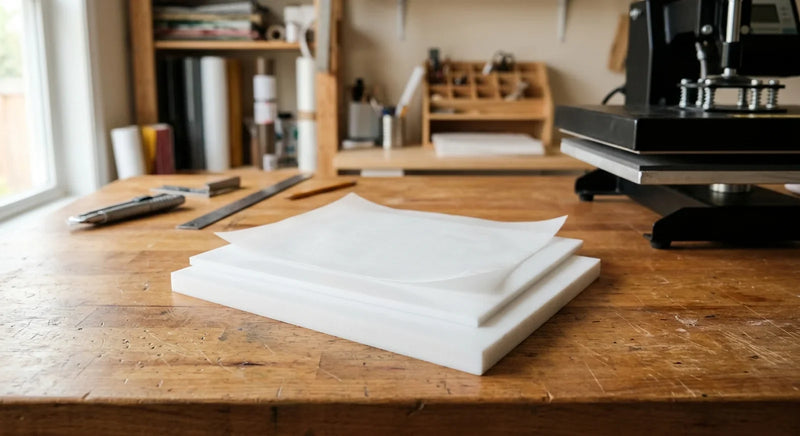
You’ve probably seen the term “glassine release paper” while shopping for craft supplies and wondered what makes it different from the silicone-coated paper you already use. It’s a fair question, and the answer matters more than you’d think - especially if you’re about to spend money on the wrong product for your project.
Let me break down what glassine actually is, where it works well, and (more importantly) where it falls short compared to modern nonstick alternatives.

What Exactly Is Glassine Paper?
Glassine is a smooth, glossy paper made through a process called supercalendering, where wood pulp sheets are pressed through heated metal rollers multiple times until the fibers flatten into an extremely dense, translucent surface. The result is a paper that resists moisture, grease, and air to a degree that regular paper can’t match.
Here’s where it gets interesting. Glassine doesn’t have any chemical coating on it. That smoothness comes entirely from the mechanical pressing process. Compare that to silicone-coated release paper, which gets its nonstick properties from an actual silicone layer bonded to the paper surface. Same general category, very different performance.
The Library of Congress actually recommends glassine for archival storage of photographs and stamps because it’s acid-free and won’t transfer chemicals to delicate items. That tells you a lot about what glassine is good at - and what it isn’t designed for.
Does Glassine Work as Release Paper for Crafts?
Glassine provides a mild barrier against sticking, but it is not a true nonstick surface and will fail under heat, pressure, or contact with adhesives like resin and vinyl. For most crafting applications, you need actual release properties that glassine can’t deliver.
Think of it like this. A waxed floor is slippery, but you wouldn’t call it nonstick. Glassine’s smooth surface reduces friction, sure, but it doesn’t actively repel adhesives the way silicone or PTFE coatings do. So when crafters try using glassine for diamond painting cover sheets, heat press liners, or resin workspace protection, things go wrong fast.
I’ve seen this come up in craft forums constantly. Someone buys a roll of glassine paper expecting it to work like the silicone release paper they’ve read about, and then their diamond painting drills stick right through it. Or their heat transfer vinyl bonds to it permanently at 305°F. The mechanical smoothness just can’t hold up to real crafting conditions.
Note: If you’re using glassine for light-duty tasks like separating sticker sheets or wrapping soap bars, it works fine. But anything involving heat, adhesive, or resin? You need a coated product.
Where Does Glassine Actually Shine?
Glassine performs best in archival, packaging, and food-service applications where moisture resistance matters more than heat tolerance or true nonstick properties.
Here’s a quick rundown of where glassine earns its keep:
Stamp and photo storage is probably the most common use. Collectors have relied on glassine envelopes for decades because the paper won’t yellow, won’t transfer acids, and provides just enough barrier to prevent items from sticking to each other in albums.
Food packaging is another strong use case. Bakeries use glassine bags for cookies and pastries because it resists grease without any chemical coating. The FDA considers glassine food-safe in its guidance on indirect food contact substances, which is why you see it in candy wrappers and deli applications too.
Interleaving printed materials is a classic application. Printers place glassine sheets between freshly printed pages to prevent ink transfer. And some soap makers use it to wrap bars because it breathes slightly while still blocking oils.

How Is Glassine Different from Silicone Release Paper?
Silicone release paper has a chemically bonded nonstick coating that actively repels adhesives, resins, and heat-activated materials - something glassine cannot do at any thickness or grade.
The difference comes down to what’s on the surface. Glassine relies on compressed fibers. Silicone release paper has an actual silicone polymer layer (typically 1-2 microns thick) that creates a low surface energy barrier. That’s the same principle behind nonstick cookware, and it’s why silicone paper can handle:
- Diamond painting adhesive without grabbing drills (try that with glassine - you’ll lose drills every session)
- Heat press temperatures up to 400°F without melting or bonding to your vinyl
- Epoxy resin that peels right off after curing, instead of tearing the paper apart
If you’re working with PTFE or FEP nonstick sheets, you’re getting even more durability. PTFE handles temperatures up to 500°F and lasts through hundreds of uses. We’ve covered the differences between FEP and PTFE in detail if you want the full comparison.
For price context, a 50-sheet pack of quality silicone release paper runs about $12 and each sheet handles 2-3 craft sessions. Glassine is cheaper per sheet (roughly $0.05-0.10 each in bulk), but it’s single-use for most applications and doesn’t actually release anything. You end up spending more replacing it.
Can You Use Glassine for Diamond Painting or Heat Press?
No. Glassine lacks the nonstick coating and heat resistance required for diamond painting cover sheets or heat press applications - using it will damage your projects.
For diamond painting specifically, the adhesive on your canvas needs a cover sheet that won’t bond to it. Silicone-coated paper has a release value (measured in grams per inch of peel force) designed specifically for this. Glassine doesn’t have a controlled release value at all. Customers who’ve switched from generic paper to proper diamond painting accessories report that their canvases stay sticky longer and they lose fewer drills per session.
For heat press work, glassine will scorch at temperatures above 250°F. Most HTV applications need 305-320°F, and sublimation runs even hotter. You need either silicone release paper or a PTFE press sheet rated for those temperatures. We covered the details of preventing press damage in our guide on demolding resin without cracking - similar principles apply to any heat-sensitive craft where surface protection matters.
And for resin crafts? Glassine will absorb resin and fuse to your project permanently. Silicone mats or silicone-coated paper are the only reliable options for workspace protection during pours.

So Should You Buy Glassine Release Paper?
If you’re storing stamps, wrapping soap, or packaging baked goods, glassine is a solid choice. It does those jobs well and costs less than coated alternatives.
But if you’re here because you need release paper for crafting - diamond painting, heat pressing, resin work, vinyl cutting, or sticker making - glassine isn’t the right product. You need paper (or sheets) with an actual nonstick coating that can handle adhesives, heat, and repeated use.
The terminology is confusing because “release paper” gets used loosely across industries. In archival and packaging contexts, glassine counts. In crafting, “release paper” almost always means silicone-coated paper or PTFE/FEP film. Make sure you know which one you’re buying!
Shop the Right Release Paper for Your Project
Done wondering about glassine? If your projects involve heat, adhesive, or resin, check out our craft supply collection - true silicone-coated release paper and nonstick sheets built for the jobs glassine can’t handle. For resin pours and epoxy work, our resin craft supplies protect your workspace session after session.
The bottom line: know what your project demands, pick the right material, and you won’t waste money on paper that tears, scorches, or sticks when you need it not to. That’s the kind of upgrade that actually saves you money over time!