A roll of PTFE looks like a simple thing. It's a long sheet of white nonstick film wrapped around a core. But the roll format changes how you work, because you stop buying sheets that almost fit and start cutting pieces that fit exactly. Heat press owners, resin makers and home bakers all end up asking the same few questions once a roll lands on the bench, so this guide answers them in order.
Quick answer: Cut PTFE roll pieces with sharp scissors or a rotary cutter, about 1 inch larger than the platen or pan they cover. Our PTFE rolls are rated to 500°F continuous, wipe clean with water and last for hundreds of projects with normal care.

What Is a PTFE Sheet Roll and Why Buy It by the Roll?
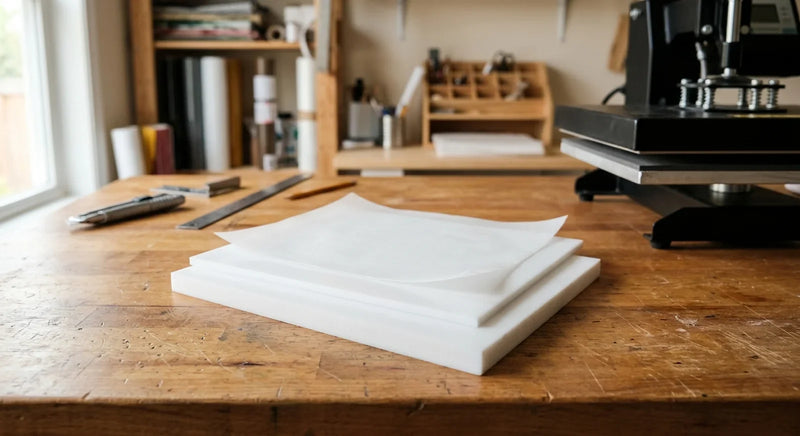
A PTFE sheet roll is a continuous length of polytetrafluoroethylene film that you cut to size yourself.
PTFE is the fluoropolymer behind most nonstick sheets, and a lot of people search for it as a "Teflon roll" (Teflon is a brand name for PTFE). The material is nonstick all the way through rather than coated, which is why it keeps releasing cleanly after the first hundred uses. The polytetrafluoroethylene entry on Wikipedia covers its low friction and its chemical inertness in more detail.
So why a roll instead of precut sheets? Three reasons:
- Fit: You cut each piece to the exact tool, whether that's a 15 x 15 in press, a 16 x 20 in press or a half sheet pan.
- Cost per piece: A 50 ft roll is 600 inches long, so it yields dozens of press-size pieces from one purchase.
- Replacement: When one piece wears out, you cut another in a minute instead of reordering.
The Kraft & Kitchen PTFE and FEP sheets collection carries our rolls in four sizes. Each one is 100% PTFE between 0.07 and 0.1 mm thick (about 2.8 to 3.9 mil):
| Roll option | Width | Length | Thickness |
|---|---|---|---|
| Single roll | 16 in | 48 in | 0.07 to 0.1 mm |
| 50 ft roll | 16 in | 50 ft | 0.07 mm |
| 50 ft roll | 16 in | 50 ft | 0.1 mm |
| 50 ft wide roll | 24 in | 50 ft | 0.07 to 0.1 mm |
Thinner film is lighter and easier to cut into detailed shapes. Thicker film adds a bit of cushion under a press. If you're weighing thickness for heat press work specifically, our PTFE thickness comparison walks through how thickness affects heat transfer.
Is a PTFE roll the same as FEP film?
No. PTFE is opaque white and rated to 500°F, while FEP is clear and rated to about 400°F.
Both are fluoropolymers, and both release almost anything. The difference that matters day to day is visibility. FEP lets you see the transfer or the resin piece underneath, which helps when you're lining up a small design. PTFE handles more heat and comes in widths big enough for a full press. Many shops keep a PTFE roll for the big jobs and a pack of 4 x 4 in clear FEP squares for small, fussy ones.
How Do You Cut a PTFE Roll Cleanly?
Unroll the film flat, measure, then cut in one smooth pass with sharp scissors or a rotary cutter on a cutting mat.
PTFE cuts easily, but it's slippery, and that's where most ragged edges come from. A few habits make every cut clean:
- Step 1: Unroll on a flat, clean surface. Let the length you need relax for a minute so it stops curling back toward the core.
- Step 2: Measure twice and mark lightly. A fine-tip dry-erase marker or a strip of painter's tape works. Both come off without residue.
- Step 3: Pin it down. Lay a metal ruler or straightedge along the cut line and press it firmly so the film can't slide.
- Step 4: Cut in one pass. A rotary cutter on a self-healing mat gives the straightest edge. Long-bladed scissors work too; take long strokes instead of short snips.
- Step 5: Round the corners. Snip each corner into a small curve. Square corners are the first spot to fold over and crease.
Dull blades chew the edge instead of slicing it. If your scissors leave a wavy or stretched edge, sharpen or replace them before cutting more pieces.
Warning: Don't fold PTFE into a sharp crease to "score" a cut line. A hard crease leaves a permanent ridge that can print a faint line onto fabric under heat.
What Size Should You Cut for Your Heat Press?
Cut the piece about 1 inch longer than your platen on each side so the film covers the whole heated surface.
That margin matters. It keeps the edge of the sheet off your design and stops stray adhesive from reaching the bare platen. Here's how the common press sizes map onto our rolls:
| Press platen | Roll to use | Cut length | Pieces per 50 ft roll |
|---|---|---|---|
| 15 x 15 in | 16 in wide | 17 in | 35 |
| 16 x 20 in | 24 in wide | 18 in | 33 |
| 9 x 12 in (small press) | 16 in wide | 11 in | 54 |
On a 15 x 15 in press, a 16 in wide roll leaves half an inch of overhang on two sides. That's enough for most transfers, and the 17 in cut length gives you a full inch at the front and back. On a 16 x 20 in press, the 24 in roll runs across the long side and an 18 in cut covers the short side with an inch to spare.
Most people cut two pieces per press: one under the garment to protect the lower platen and one over the transfer. The top sheet blocks adhesive and ink from reaching the upper platen, and hot vinyl won't stick to it. Our PTFE heat press protection guide covers placement for layered transfers and sublimation in more detail.
Pro Tip: Cut one spare top sheet and keep it beside the press. When the working sheet picks up residue mid-session, swap it and clean the dirty one later.
You'll find the rest of the press setup (silicone release paper, clear FEP cover sheets and silicone pads) in our heat press supplies collection.

Can You Use a PTFE Roll in the Oven or Kitchen?
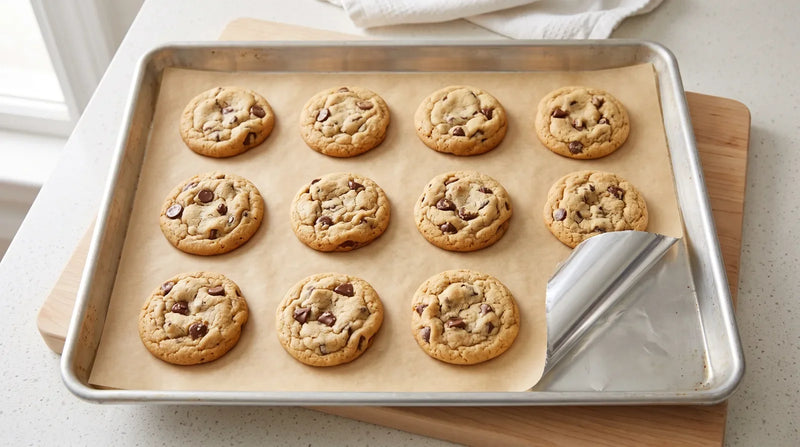
Yes, as a pan or rack liner up to 500°F, but never under a broiler or over open flame.
PTFE film works as a reusable baking liner. Cookies, roasted vegetables and sticky candy lift off it without parchment, and it rinses clean afterward. PTFE resins are an approved food-contact material under the FDA rule for perfluorocarbon resins, 21 CFR 177.1550.
The heat limit is the part to respect. Our rolls are rated to 500°F continuous and aren't made for direct flame. Overheated PTFE gives off fumes that can cause polymer fume fever in people, and pet birds are especially sensitive to them. So the kitchen rules are short:
- Keep the oven at or below 500°F.
- Don't use PTFE under the broiler, on a grill grate over flame, or on a stovetop burner.
- Don't preheat an empty pan with the liner inside at maximum heat.
- Keep birds out of the kitchen when anything nonstick is running hot.
What size liner fits a sheet pan?
A half sheet pan's flat bottom is roughly 16.5 x 11.5 in, so a 16 x 11.5 in cut from a 16 in roll fits inside the rim.
Measure your own pans first, because brands vary by half an inch or more. Trim the liner so it lies flat on the bottom without riding up the sides. A liner that climbs the walls can curl over into the heat.
How does PTFE compare with the paper options? Parchment is single-use and usually rated lower. Our foil-backed parchment guide covers when a disposable liner still makes more sense, like wrapped roasts and messy marinades. For a heavier reusable surface on the counter, the heat-resistant silicone counter mat in our silicone pads and trivets range sits well under hot pans. The kitchen and culinary collection rounds out the baking setup.
How Do You Use a PTFE Roll for Resin Work?
Lay PTFE under molds and pours as a bench liner, because cured epoxy and UV resin don't bond to it.
Resin drips are the classic reason a craft table gets ruined. A PTFE liner catches them, and once a drip cures you peel it off in one piece. It works in a few spots:
- Bench liner: Cut a piece the size of your pour area and tape the corners down.
- Under silicone molds: Overflow cures on the PTFE instead of the mold base, and the mold lifts off clean.
- Flat-casting surface: Pour small flat pieces like bookmarks directly onto taped-down PTFE. The underside comes out smooth.
- Sanding and trimming station: Cured shavings brush off the film easily.
Let resin cure fully before you peel it. Wiping wet resin smears it across the sheet. A fully cured drip pops off with a fingernail.
Note: PTFE gives a smooth, glossy release, but it won't add texture or a matte finish. If you want a textured back, that comes from the mold, not the liner.
Our resin and epoxy craft supplies collection has the counter mats, release paper and resin additives that pair with a PTFE liner. And if your pieces are cracking on the way out of the mold, our guide to demolding resin without cracking it covers timing and technique.

How Do You Clean, Store and Replace PTFE Pieces?
Wipe PTFE with water or mild dish soap and a soft cloth, then store it flat or loosely rolled.
PTFE doesn't absorb oils, so most residue sits on the surface. Here's the routine that keeps a piece working for hundreds of cycles.
How should you clean it?
Use warm water, a drop of dish soap and a soft cloth or sponge.
For dried adhesive or cured resin, let the sheet cool fully and peel or brush the residue off. Isopropyl alcohol on a cloth lifts sticky vinyl adhesive. Skip abrasive scrub pads and steel wool, since scratches hold residue and wear the surface faster.
How should you store it?
Store cut pieces flat in a folder or drawer, and keep the uncut roll loosely wound on its core.
Don't wrap the roll tightly around something narrow, and don't stack heavy tools on it. Both leave kinks. Keep it away from sharp tools in the same drawer, because a puncture is the one kind of damage you can't fix.
When should you replace a piece?
Replace a PTFE piece when it has a hole, a tear, a deep crease or residue that no longer wipes off.
Discoloration alone isn't a reason to toss it. A tan or gray tint from heat and dye is common, and the release still works. But a crease will print onto fabric, and a hole lets adhesive through to the platen. When either shows up, cut a fresh piece from the roll and move the old one to resin bench duty, where small flaws don't matter.
How many uses should you expect? It depends on heat, pressure and what touches the sheet. Gentle kitchen use and resin lining wear PTFE very slowly. High-heat sublimation at full pressure wears it fastest. If you also use silicone release paper, our guide on how many times you can reuse silicone paper explains how the paper side of the shelf ages.
Shop Related Kraft & Kitchen Products
A PTFE roll is the most flexible nonstick surface we sell, because one roll covers the press, the resin bench and the oven. Pair it with the options below to cover every release job in your space.
- Release paper and nonstick sheets - silicone release paper and precut sheets for jobs where a disposable surface is easier.
- Bulk pricing - discounts apply automatically: 5% off at 5 rolls, 10% at 10 and 15% at 25.
Which PTFE Roll Should You Start With?
Start with the 16 x 48 in single roll if you have one small press, and a 50 ft roll if you press, pour or bake every week.
The single roll gives you two 16 x 17 in press pieces with room to spare, which is enough to test the film on your own setup. A 50 ft roll at 16 in wide is the workhorse for 15 x 15 in presses and sheet pans. If you run a 16 x 20 in press, go straight to the 24 in wide roll so every piece covers the full platen.
Whatever size you pick, the same three rules carry the most weight. Cut with a sharp blade, keep it at or below 500°F, and store it without creases. Do those, and one roll lasts a long time.