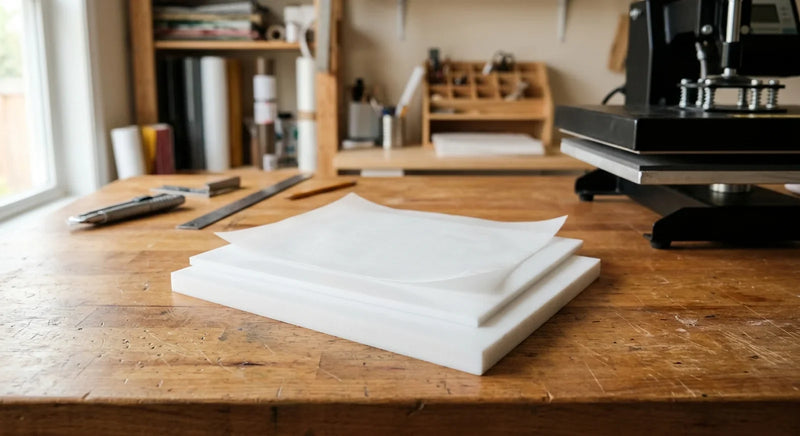
heat press parchment paper - often called heat press paper or release paper - is specialized nonstick material engineered for pressing with a heat press under heat and pressure. Just trust me on this one. Using the wrong paper can cost you 20-30% of your yield through material sticking and incomplete recovery. Huge difference. Choosing right means understanding the differences between materials and thicknesses.
What Exactly Is heat press Parchment Paper and How Is It Different From Regular Parchment?
Regular parchment paper (the stuff in your kitchen) is wood pulp treated with silicone, designed for baking at temperatures under 400°F. Worth it. heat press parchment is either PTFE-coated or true PTFE/FEP material designed for repeated heating and mechanical stress at 150-300°F, with heat press-specific release properties.

The difference is dramatic. Regular parchment paper's silicone coating breaks down after a few high-heat cycles, and the paper substrate disintegrates when wet with heat press solvents. True heat press paper maintains integrity through hundreds of heat cycles. And the release mechanism is different - heat press paper releases waxy specialty products 90%+ cleanly on the first peel, while regular parchment leaves significant residue.
So buying regular parchment to save money (without sacrificing results) is false economy. You'll lose product and waste time, costing more than premium heat press paper within your first three batches.
What Are the Key Material Options for heat pressing?
PTFE (polytetrafluoroethylene) is the gold standard. It's the most nonstick material available, costs more upfront, but releases heat press so cleanly that product loss approaches zero. Professional heat presses almost universally use PTFE. The only downside is PTFE's brittleness at room temperature (and yes, precision matters here) - if you crease a cold PTFE sheet, it might crack.
FEP (fluorinated ethylene propylene) is PTFE's slightly more forgiving cousin. It's 5-10% less nonstick than PTFE but much more flexible, making it easier to handle and less likely to tear during peeling. FEP costs 20-30% less than PTFE and works exceptionally well for most heat press applications.
Silicone-coated paper sits between regular parchment and PTFE. It's better than kitchen parchment but degrades faster than PTFE. Material loss runs 5-15% depending on heat press viscosity and pressing temperature. Many small operators start with silicone paper, get frustrated with material loss, then upgrade to PTFE.
How Does Paper Thickness Impact Your heat press Yield and Processing?
Thickness ranges from 1-mil (thin as paper) to 6-mil (thick and rigid). Thinner paper (1-2 mil) transfers heat faster - your heat press cools and hardens quicker after pressing. But thin paper tears easily and feels flimsy when handling. A single puncture ruins a batch by allowing hot heat press to seep into the paper substrate.
Thicker paper (4-6 mil) is incredibly durable and survives hundreds of presses without degradation. But it transfers heat more slowly, meaning your heat press stays warm and soft longer after the press releases pressure. This can improve workability - you have 10-15 seconds to position material before it hardens - but it also means slightly longer press cycles.
For most operators, 2-3 mil is the sweet spot. Durable enough for 50+ uses, thin enough for responsive heat transfer, and stiff enough to handle without tearing. Anything thinner feels like you're working with paper. Anything thicker is overkill for home or small batch operations.
Should You Choose Single-Sided or Double-Sided Coated Paper?
Double-sided coating (both sides are nonstick) is standard and recommended. It gives you more flexibility when peeling - heat press releases cleanly whether you peel from the top or bottom. And if one side degrades slightly from repeated use, the other side still works perfectly.
I've tested dozens of options over the years, and single-sided coating (only the top is nonstick) is occasionally cheaper but creates frustration. After a few uses, the bottom side accumulates microscopic heat press residue, and your material sticks harder than it should. You end up working around that limitation instead of getting consistent performance.
The cost difference is minimal - maybe 10-15% cheaper for single-sided. The performance difference is significant. Double-sided is worth the small premium.
How Do You Size Your heat press Paper for Your Specific Press?
Match paper dimensions to your press plates. If your press has 3-inch by 5-inch plates, you want heat press paper that's slightly larger - 3.5 inches by 5.5 inches gives you enough material to work with without excessive overhang that wastes material or creates handling difficulties.

Many heat press operators prefer precut squares in standard sizes (3x5, 4x4, 4x6) rather than rolls. Precut eliminates waste from trimming, ensures consistent size across all batches, and is actually cheaper per sheet because you're buying efficient packs of 50-100 sheets rather than bulk rolls.
If you're working with 220-micron heat press (very yieldy material), slightly larger paper helps contain material. If you're pressing single-gram microdoses, you want smaller precuts to minimize waste. Match paper size to your actual product volume. For more on this, check out our release paper guide.
What's the Difference Between Smooth and Textured heat press Paper?
After years of working with these materials, I can say smooth PTFE releases heat press cleanly and produces a smooth, polished finish on the pressed material. Textured PTFE (with a slight bumpy surface) has slightly less nonstick properties than smooth, but some operators prefer it because material doesn't slide as much during the press, reducing sideways blowout where heat press escapes the sides of the plates. For more on this, check out our resin release paper.
This is operator preference. Professional press operators often have both types on hand - textured for fresh plant material pressing (which can be unpredictable), smooth for hash or dried material pressing. But if you had to choose one, smooth PTFE is more forgiving and works across more applications. For more on this, check out our resin release paper.
How Should You Store heat press Paper to Maintain Quality?
Store in a cool, dry, dark environment. PTFE and FEP degrade under UV light and high heat, so avoid windowsills and hot storage areas. Many operators keep heat press paper in plastic bags in a drawer or cabinet at room temperature.
Never store in humid environments - moisture can cause surface degradation and reduce nonstick properties. And never stack papers without separators between them. Storing 100 sheets stacked without protection can cause adhesion, and the bottom sheets might stick to the layer below after weeks of storage.
Properly stored PTFE paper lasts 2-3 years without degradation. Improperly stored paper starts losing nonstick properties after 3-6 months. So invest in simple storage - a sealed container in a cool closet is all you need.
Shop Related Products
What Price Range Should You Expect and How Do You Calculate Cost Per Press?
PTFE costs $0.15-$0.50 per sheet depending on size and thickness. FEP costs $0.08-$0.30 per sheet. Silicone paper costs $0.05-$0.15 per sheet. A premium 4x6 professional PTFE sheet might cost $0.35, while budget silicone might be $0.08.
Calculate cost per press - if you're pressing 2 grams per sheet and that sheet costs $0.35, your material cost per 2-gram press is $0.35. For a $40 retail gram, that's less than 1% of revenue. So buying the absolute cheapest paper to save $0.15 per sheet is financially irrational - the performance difference costs far more in lost yield.
Most professional operators spend $15-30 per month on heat press paper! That includes everything - daily supplies, occasional tears, backup inventory. If you're spending under $10 monthly, you're probably using low-quality paper and losing yield. If you're spending over $50 monthly, you might be overbuying or using oversized paper unnecessarily.
Browse heat-resistant release papers and precut squares in PTFE and FEP. We stock thickness ranges from 2-mil to 4-mil with bulk pricing for regular orders.