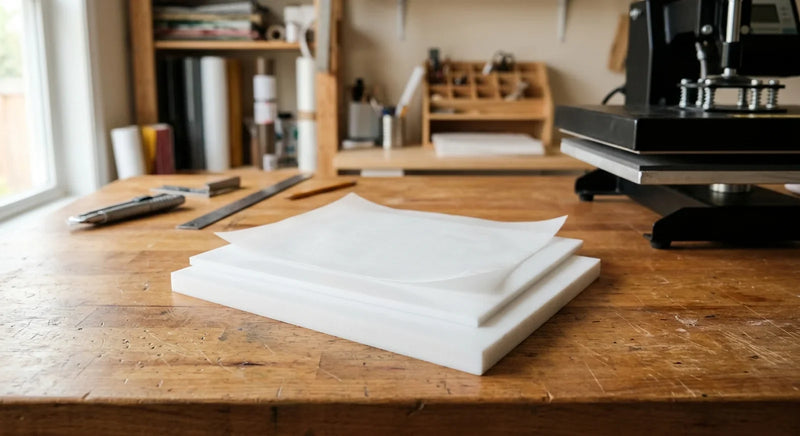
Choosing between silicone, PTFE, and FEP feels technical, but the decision directly impacts your processing yield, processing speed, and product quality. Been there. Each material behaves differently under heat, has different cost implications, and degrades at different rates - pick wrong and you're wasting product. Been there.
What Are the Core Properties That Distinguish These Three Materials?
Silicone is a polymer with excellent flexibility and reusability. PTFE (polytetrafluoroethylene, commonly called Teflon) is a fluoropolymer known for extreme nonstick properties and temperature (and yes, precision matters here) resistance. FEP (fluorinated ethylene propylene) is similar to PTFE but slightly less heat-resistant and more flexible, which some prefer for handling.

These aren't interchangeable. Silicone releases material well but can absorb oils and aromatic compounds over repeated use, eventually degrading. PTFE releases everything efficiently but costs more and can't be reused as many times. FEP sits in the middle - better release than silicone, lower cost than pure PTFE, and acceptable heat resistance.
Performance varies with thickness too. A 4-mil professional PTFE sheet releases far better than a 1-mil PTFE sheet. Material quality matters more than just knowing the name.
What Temperature Ranges Does Each Material Handle?
Silicone typically handles continuous temperatures up to 400°F, though some high-grade silicone extends to 500°F. But here's the catch - silicone starts breaking down in your processing oils around 350°F! If you're pressing heat press at 200°F, silicone is fine. If you're processing high-heat specialty products, it degrades.
PTFE is the temperature champion, handling continuous use up to 500°F and surviving brief exposure to 600°F. And unlike silicone, PTFE doesn't leach into oils or degrade in solvents, making it ideal for solvent-based processing work! The downside is brittleness at extreme cold - PTFE becomes fragile below 30°F.
FEP bridges the gap, handling continuous use up to 400°F (100°F less than PTFE) with better cold flexibility. For most specialty processing work between 150-350°F, FEP is adequate and costs 30-40% less than PTFE.
Which Material Works Best for heat pressing?
heat pressing happens at 150-250°F typically, so temperature isn't the limiting factor - nonstick performance is. PTFE dominates here because heat press, especially when pressing fresh flower, contains heavy soft product content that sticks aggressively. A premium PTFE sheet releases heat press 95% clean on the first peel. Silicone under the same conditions leaves 15-25% residue on the mat.
But PTFE costs 50% more than silicone. Many small heat press producers start with silicone, get frustrated with material loss, then upgrade to PTFE. So do the math for your volume. If you're pressing 100 grams per week, the material loss from silicone costs more than upgrading to PTFE. If you're pressing 5 grams per week, silicone makes economic sense.
For maximum efficiency, get precut PTFE squares in your exact press size - it reduces waste on trimming and ensures consistent release properties across the surface.
What About oil processing and Solvent-Based processing?
Silicone absolutely can't touch hydrocarbons. Butane, propane, and similar solvents dissolve silicone, causing material loss and product contamination. So silicone is completely off-limits for oil processing - period.

My go-to approach is pTFE is solvent-resistant. Even aggressive solvents like hexane barely affect PTFE, which is why it's standard in professional solvent labs. But here's the trade-off - PTFE's slickness is so extreme that holding pressed material briefly becomes difficult. So solvent processors sometimes use FEP temporarily, then transfer to PTFE for storage.
FEP occupies an interesting middle ground. The ASTM plastics standards classify FEP and PTFE as fluoropolymers with distinct thermal profiles. It's more solvent-resistant than silicone (though not as bulletproof as PTFE), costs less, and handles the material transfer without the extreme slickness. For small-scale oil processing operations, FEP is practical.
How Does Material Thickness Affect Performance and Durability?
Thickness ranges from 1-mil to 6-mil sheets, and thickness directly impacts longevity. A 1-mil sheet feels papery and tears easily. A 4-mil sheet is durable enough for hundreds of uses. A 6-mil sheet is rigid and lasts through 500+ uses before noticeable degradation.
But thicker isn't always better. Thicker material means higher heat transfer lag, so pressing times extend slightly. A 6-mil PTFE sheet on a heat press takes 3-5 seconds longer to release heat than a 2-mil sheet. For high-volume pressing, that time compounds. For more on this, check out our heat press mistakes to avoid.
Material cost scales linearly with thickness, so doubling thickness doubles cost. Most professionals land on 2-4 mil - thin enough for responsive heat transfer, thick enough for 100+ uses without tearing. Get nonstick paper and sheets in your preferred thickness and material combination.
What's the Real Cost Comparison When You Factor in Reusability?
Silicone costs $0.50 to $2.00 per square foot. PTFE costs $4.00 to $8.00 per square foot. FEP costs $2.50 to $5.00 per square foot. But a single PTFE sheet lasts 300+ uses while silicone lasts 50-100 uses before degrading enough to require replacement. For more on this, check out our choosing nonstick sheets.
I've found that so the per-use cost of PTFE is often lower than silicone despite the higher upfront price. But reusability depends on maintenance. Properly cleaned and stored PTFE lasts years. Carelessly used PTFE tears or stains and becomes unusable in months. For more on this, check out our PTFE sheet guide.
Calculate your actual cost: material cost divided by expected useful life in uses, multiplied by your weekly throughput. Factor in labor to clean and maintain the material. For most mid-scale operations (50+ grams processed per week), PTFE breaks even within three months against silicone replacement costs.
Shop Related Products
How Should You Store These Materials to Extend Lifespan?
All three materials degrade under UV light and high heat, so store in cool, dark, dry conditions. Silicone can stick to itself over time when rolled or stacked, so separate layers with parchment or tissue paper. PTFE is brittle when cold, so don't bend it at temperatures below 40°F.
From what I've seen, never store any of these materials touching rubber or certain plastics - chemical reactions can cause permanent staining. And always clean material immediately after use. Dried residue hardens overnight and becomes nearly impossible to remove without damaging the nonstick surface.
Proper storage extends lifespan by 50-100%. Poor storage - humid conditions, direct heat, stacking without separators - cuts useful life in half.